Every year when the bright full moon rises in autumn, families across China gather to celebrate the Mid-Autumn Festival, and one food is always on the table: mooncakes. But why mooncakes? The short answer is that a mooncake is round, and in Chinese culture, roundness stands for family reunion. The longer answer involves blessings, a famous legend, and a comparison table of festival foods that will help you talk about Chinese holidays with confidence. Let me walk you through it.
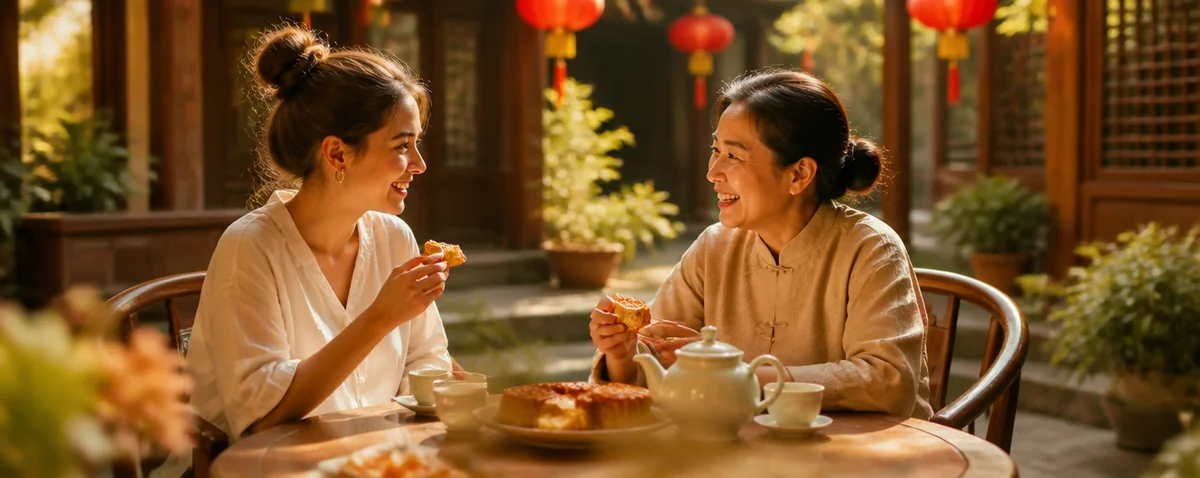 Conceptual illustration of two women sharing mooncakes and tea during the Mid-Autumn Festival
The Round Shape Means Reunion
In Chinese culture, the full moon represents family reunion and togetherness. Mooncakes, with their perfectly round shape, mirror that full moon and symbolize completeness and unity. Eating mooncakes under the moonlight is a way of wishing that the family will always stay whole and harmonious.
The word 月饼 literally means “moon cake,” and the round shape is the whole point. Here is a sentence you will hear at every family table:
Wǒ men yì jiā rén yì qǐ chī yuè bǐng.
我们一家人一起吃月饼。
Our whole family eats mooncakes together.
yuán yuán mǎn mǎn
圆圆满满
complete and whole
圆圆满满 is a favorite festive blessing. It repeats the word for “round” (圆) to emphasize completeness, echoing both the moon and the mooncake. Wish someone 圆圆满满 and you are wishing them a life as full and perfect as the mid-autumn moon.
A Gift of Blessings
During the festival, people do not just eat mooncakes, they exchange them as gifts with family, friends, and colleagues. A box of mooncakes shows care, respect, and good wishes. In many offices, gifting mooncakes is as normal as sending Christmas cards, and it is a meaningful way to strengthen relationships.
sòng yuè bǐng
送月饼
give mooncakes as a gift
Zhù nǐ jié rì kuài lè!
祝你节日快乐!
Wish you a happy festival!
You can use 祝你节日快乐 as a general holiday greeting, and it works perfectly when you hand someone a box of mooncakes. For more of the customs surrounding this exchange, our guide to
Mid-Autumn Festival customs explains the full picture.
Stories Hidden in Mooncakes
Mooncakes also carry legends. The most famous tale dates back to the Yuan Dynasty, when rebel leader Zhu Yuanzhang planned an uprising against the rulers. To pass the secret message around without being caught, his people hid the plan inside small cakes. The message traveled safely, the rebellion succeeded, and mooncakes became forever linked to cleverness and freedom.
yǒu jí xiáng tú àn
有吉祥图案
with lucky patterns
Today, even without hidden notes, each mooncake often has beautiful characters or symbols stamped on top, carrying meanings like “harmony” or “longevity.” These patterns keep the festive spirit alive in every bite. Learning to recognize these characters is a small step in a larger journey, and our
guide to the benefits of studying Chinese explains why that journey is worth taking.
Festival Foods Comparison
Now that you know why mooncakes matter, here is a quick comparison to help you keep all the festival foods straight. Each Chinese festival has its own special food, and knowing them is a great conversation starter.
| Festival |
Food |
Pinyin |
English |
| Mid-Autumn Festival |
月饼 |
yuè bǐng |
mooncake |
| Lantern Festival |
汤圆 |
tāng yuán |
glutinous rice balls |
| Dragon Boat Festival |
粽子 |
zòng zi |
rice dumplings |
| Everyday |
饺子 |
jiǎo zi |
dumplings |
| Everyday |
面条 |
miàn tiáo |
noodles |
| Everyday |
火锅 |
huǒ guō |
hotpot |
A quick way to remember them: 汤圆 (tāng yuán) are the traditional food for the Lantern Festival, and 粽子 (zòng zi) belong to the Dragon Boat Festival, while mooncakes 月饼 (yuè bǐng) are the food of Mid-Autumn. If you want to practice using these words in real conversations, our
everyday Chinese phrases for self-introduction is a helpful companion.
Common Questions About Mooncakes
Why are mooncakes round?
Mooncakes are round to mirror the full moon, which in Chinese culture symbolizes family reunion and completeness. The round shape carries the central wish of the festival: that families stay whole and harmonious. This is the simplest answer to why mooncakes matter so much.
When did Chinese people start eating mooncakes?
The mooncake as we know it became widely popular during the Yuan Dynasty, around the 14th century, when the famous legend says secret messages were hidden inside the cakes. Earlier round pastries existed for moon worship, but the festive gifting tradition we see today really took shape in the Yuan and Ming periods.
What is inside a traditional mooncake?
Traditional mooncakes have a thin, golden crust and a dense filling. The most classic fillings are lotus seed paste (莲蓉, lián róng), red bean paste (红豆沙, hóng dòu shā), five-nut filling (五仁, wǔ rén), and salted egg yolk (咸蛋黄, xián dàn huáng), which is often placed in the center to resemble the full moon.
Are mooncakes only for the Mid-Autumn Festival?
Mooncakes are most closely tied to the Mid-Autumn Festival, and that is when almost all of them are eaten and gifted. You can find them in stores for a short season around the festival, but they are rarely eaten at other times of year. So in a real sense, yes, they are a festival-only food.
Celebrate with Sweet Unity
Mooncakes are not just pastries. They are symbols of reunion, blessing, and cultural tradition. By tasting them, sharing them, and knowing their stories, you connect more deeply with the meaning of the festival. At eChineseLearning, our native teachers guide you beyond vocabulary lists, helping you build real conversation skills and cultural understanding.
Book a free 30-minute trial lesson and bring your Chinese to life this festival season. You might also enjoy our
one-on-one Chinese speaking classes for continued practice.
Founded in 2006 | Serving 100+ Countries


Answer: B. Because round shapes symbolize family reunion
✔️ This is the cultural meaning behind mooncakes.
❌ A is practical but not cultural.
❌ C is half true but misses the deeper meaning.