


12-year-old Solo Uniacke, also known as You Zijun (尤子俊), the son of Oscar-winning actress Rosamund Pike, won the prestigious “Chinese Bridge” competition for young Mandarin learners. His success offers valuable lessons for any family considering Chinese education for their children. In this article, we explore how Solo developed his Mandarin skills, the role his family played, and what parents can learn from his journey.
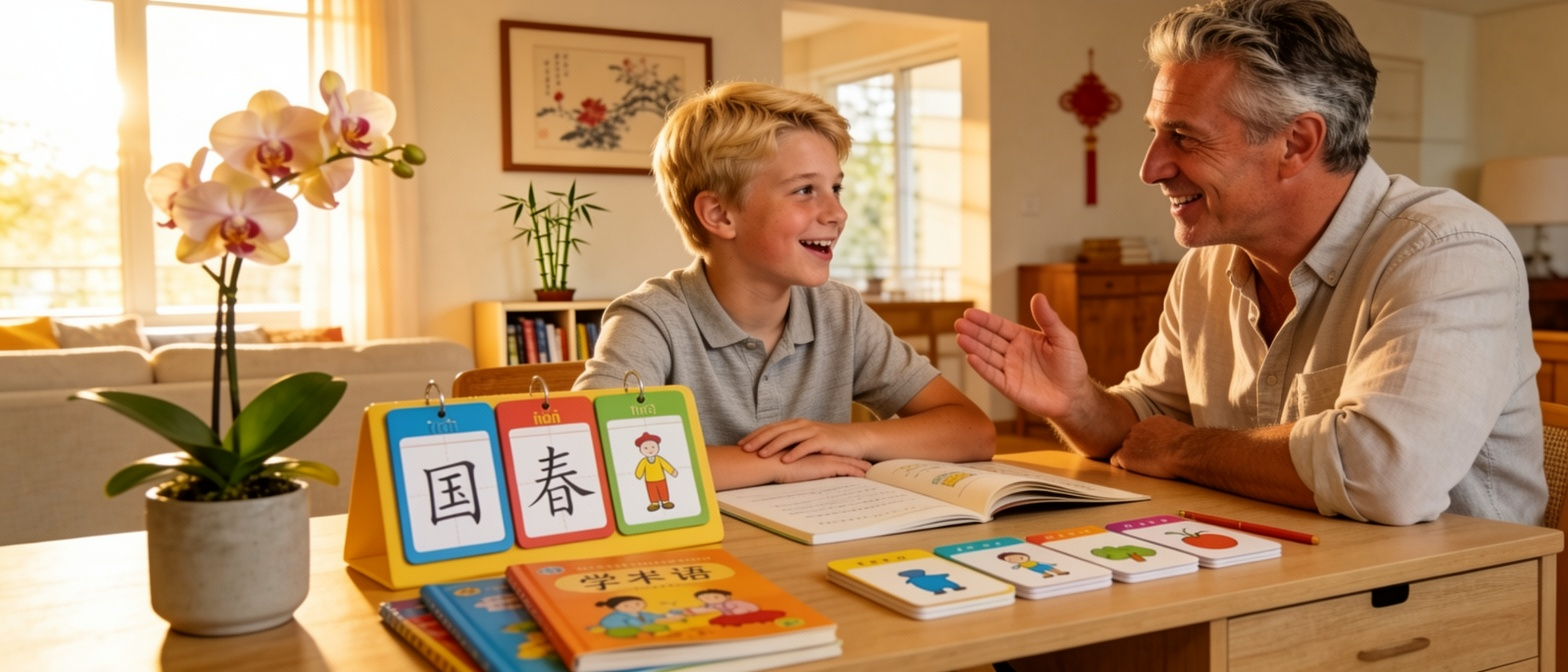
Conceptual illustration of children engaged in Mandarin learning activities.
How You Zijun Started Learning Mandarin
Solo Uniacke began his Mandarin learning journey at the age of three. Growing up in a multicultural household, Solo was exposed to various languages from an early age. However, it was his family’s deep interest in Chinese culture that made Mandarin a natural focus.
His mother, Rosamund Pike, had spent time in China for both work and personal exploration. She recognized the importance of Mandarin as a global language and a bridge to understanding China’s rich history and traditions. She encouraged her son to learn Chinese not just for academic reasons, but to embrace the depth of Chinese culture.
In 2015, Rosamund visited China to promote her film Gone Girl. During the visit, she shared the story behind her Chinese name, 裴淳华 (Péi Chúnhuá – her chosen Chinese name), and asked event organizers to call her by this name out of respect for Chinese culture. Rosamund has openly expressed her appreciation for China, and it was in this environment of cultural curiosity that Solo’s Mandarin journey began.
The Role of Family Support in Language Learning
The role of parents in a child’s language-learning journey is significant. Rosamund Pike and her partner Robie Uniacke’s support has been instrumental in Solo’s development. Rosamund understood the value of language skills and actively participated in her son’s learning process. Her involvement went beyond helping with vocabulary — she nurtured a genuine passion for Chinese culture.
Robie Uniacke, who is self-taught in Mandarin, has also been actively involved. He not only speaks Chinese himself but has taught Mandarin to both of their sons. This family-wide commitment created an immersive environment where Chinese was part of daily life, not just a subject studied at a desk.
Before Solo competed in the “Chinese Bridge” competition, Rosamund recorded a heartfelt video wishing him and all the other contestants good luck. This encouragement helped keep Solo motivated, not only during the competition but throughout his long-term Mandarin learning journey.
For parents who want to support their children’s Chinese learning, here is a useful phrase to practice together:
Pinyin:
Wǒ ài xué Zhōngwén.
我爱学中文。
I love learning Chinese.
The Chinese Bridge Competition
The “Chinese Bridge” competition, organized by Hanban (the Confucius Institute Headquarters), is held annually and invites young Mandarin learners from around the world to showcase their fluency and cultural knowledge. Solo competed in the primary school category, where thousands of students participate each year, making it a highly competitive event. For Solo, the competition was an opportunity to demonstrate years of consistent effort.
During the final round, Solo’s deep understanding of Chinese culture, combined with his fluency in Mandarin, impressed the judges. When asked about his journey, Solo expressed his appreciation for China and its people, sharing that he had been studying Chinese since age three and planned to continue learning.
“The first blonde-haired Chinese person.”
— Solo Uniacke, humorously describing himself at the Chinese Bridge competition
This remark delighted the audience and showcased his confidence and charm. His younger brother, Atom (Chinese name: You Ziyuan, 尤子源), also speaks Mandarin and participated in the competition alongside him. Having a sibling who shares the same language-learning journey can provide motivation and a practice partner — something many families find valuable.
If your child is interested in Chinese culture, you can start with a simple greeting:
Pinyin:
Nǐ hǎo, wǒ jiào Solo.
你好,我叫Solo。
Hello, my name is Solo.
What Parents Can Learn from Solo’s Journey
Solo’s story highlights several key takeaways for families considering Mandarin education:
- Start early, but focus on consistency: Solo began at age three, but the key factor was consistent practice over nearly a decade. Starting early gives children more time to absorb tones and characters naturally.
- Create a culture-rich environment: The Uniacke household didn’t just study Chinese — they embraced Chinese culture through food, media, and personal connections. This cultural immersion makes learning meaningful rather than mechanical.
- Parental involvement matters: Both Rosamund and Robie actively participated in their children’s learning. When parents show genuine interest, children are more likely to stay motivated.
- Make it a family activity: Solo and Atom learned together, which created a supportive and competitive environment. Learning alongside a sibling or parent can make practice feel like play rather than work.
- Connect language to real experiences: Solo’s family visited China, engaged with Chinese communities, and used the language in authentic contexts. Real-world application reinforces classroom learning.
📋 Quick Summary: 5 Keys to Success
| Key Factor | How Solo’s Family Did It |
|---|---|
| Start early | Began Mandarin at age 3 |
| Consistency | Nearly a decade of regular practice |
| Cultural immersion | Chinese food, media, and personal connections at home |
| Parental involvement | Both parents actively participated in learning |
| Real-world practice | Visited China, engaged with Chinese communities |
For parents looking for structured support, one-on-one Chinese speaking classes can provide personalized guidance tailored to each child’s pace and interests. Unlike group classes with fixed curricula, personalized lessons adapt to what your child finds engaging — whether that’s Chinese songs, stories, or cultural topics.
How eChineseLearning Supports Young Mandarin Learners
Many parents wonder how to create the kind of immersive, personalized learning environment that helped Solo succeed. At eChineseLearning, we have been helping students from many countries learn Mandarin since 2006 through online Chinese speaking classes designed for learners of all ages.
Our teaching methodology is designed based on established language education principles:
- Customized instruction: Every child’s lessons are tailored to their interests, learning pace, and goals — just as Solo’s learning was shaped by his family’s cultural passions
- Consistent practice: Our teachers are available 24/7, making it easy to maintain the regular practice schedule that leads to long-term progress
- Cultural integration: Lessons go beyond vocabulary and grammar to include Chinese culture, traditions, and real-life contexts
- Interactive courseware: We use engaging multimedia materials rather than static textbooks, keeping young learners interested
Parents can also access free Chinese learning resources to support learning at home between lessons.
Chinese Phrases for Kids Starting Their Mandarin Journey
Here are some simple phrases that parents and children can practice together:
Pinyin:
Xièxie māma.
谢谢妈妈。
Thank you, Mom.
Pinyin:
Wǒ xǐhuān xué Zhōngwén.
我喜欢学中文。
I like learning Chinese.
Pinyin:
Jīntiān wǒmen xué shénme?
今天我们学什么?
What are we learning today?
Pinyin:
Zhōngwén hěn yǒuyìsi.
中文很有意思。
Chinese is very interesting.
Your first lesson is on us — no cost, no commitment.
If a lesson ever falls short of your expectations, you will not be charged for that class, and we will provide a free make-up lesson to help you continue your learning journey.
FAQ
eChineseLearning | Founded in 2006 | Serving 100+ Countries